For the 2024-2029 mandate, European publishers call on the European Parliament to uphold a vibrant publishing sector, the largest cultural industry in Europe, ensuring that we can continue to freely publish a wide variety of books, guaranteeing freedom of expression, a plurality of opinions and our democratic values.

Search
Members Login
Contact us
European Book Publishing Statistics 2024
21 November 2025
The Federation of European Publishers (FEP) represents 31 national associations of publishers of books, learned journals and educational materials, in all formats, in Europe. The present survey is based on reports from the national book publishing associations and on further analysis and refining of data for the year 2024. Since 2019, the survey has been based on a new questionnaire, which in the short term will entail limited comparability with some older data.
The main figures on the overall economic significance of the publishing industry refer to net publishers’ turnover, i.e. the publishers’ total revenues from the sales of books, not the total market for books (margin of booksellers or other retailers) – which is estimated separately. They also do not account for revenues in terms of selling rights for translation, audiovisual adaptation, etc. In some cases, only data on market value was available; in such cases, average discount rates were applied to calculate an approximation of net turnover. Figures were rounded conservatively.
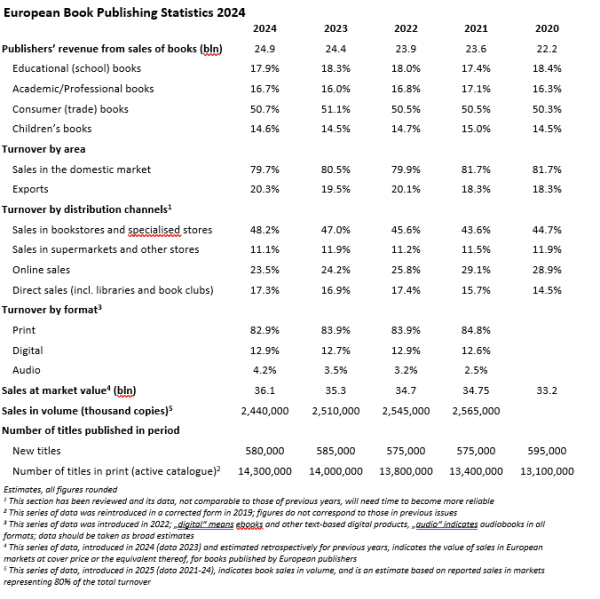
The total annual sales revenue of book publishers in Europe in 2024 was approximately € 24.9 billion, according to the survey conducted by FEP. This represents a small increase from 2023 (about 2.2%), the result of mixed outcomes across countries. The largest markets in terms of publishers’ turnover were Germany, the UK, France, Spain and Italy. While total turnover is at its highest level ever, this is only in nominal terms: considering inflation, there has been a loss of turnover in the same period of more than 30%. Total market value is estimated at € 36.1 billion (from sales of European publishers’ books), for a total consumer expenditure of some 37-39 billion €. For the first time, FEP has built a time series with data on book sales in units; the estimate for 2024 is of around 2.5 billion copies sold. However, the trend in the last few years shows a decrease in sales in volume.
A total of about 580,000 new titles were issued by publishers in 2024, a small decrease from 2023, also the result of different situations in each country. The figure was taken from different sources, some of which included new editions or non-commercial titles, and was rounded conservatively. European publishers held about 14.3 million different titles in stock (some 3.4 million in digital format), the countries reporting the largest availability being the UK, Germany, Italy, France and Spain; this figure has been spiked by the surge in digital publishing, the digitisation of back catalogues, the growth of print-on-demand services and the surge in self-published titles, as well as other phenomena. The countries reporting the largest new titles output were the UK, Germany, Spain, Italy and France.
Employment remains an area where it is difficult to gather reliable data. The entire book value chain (including authors, booksellers, printers, designers, etc.) is estimated to employ more than half a million people.
Looking at longer-term trends, up to 2007, there was steady growth both in revenues and titles. The 2008 economic crisis had less of an impact on publishing when compared to most other sectors, but revenues decreased or stagnated until 2014. After 2010, the ebook market grew fast, and exports performed well. After a pause in 2018, the positive trend resumed in 2019. 2020, the year for the pandemic, saw first a very negative impact of the health crisis, but closed with a result only moderately negative, albeit as the result of many different situations and factors. The pandemic also pushed digital sales up. 2021, while witnessing an impressive – though uneven – recovery, was also the year in which a paper crisis began. In 2022-24, turnover grew overall, but at a much slower pace and driven by prices, with the impact of the paper crisis and geopolitical instability being felt. The ebook market (now around 13% of the total) showed signs of stagnation for the 5 years before Covid (but it could be a matter of capturing the right data), whereas audiobook sales exploded in 2019, giving new impetus to digital sales; they reached 4.2% of the total in 2024 (but the figure is largely underestimated).
For further information: Enrico Turrin, +32 2 776 84 64 - eturrin(a)fep-fee.eu
PDF version


 RSS
RSS